
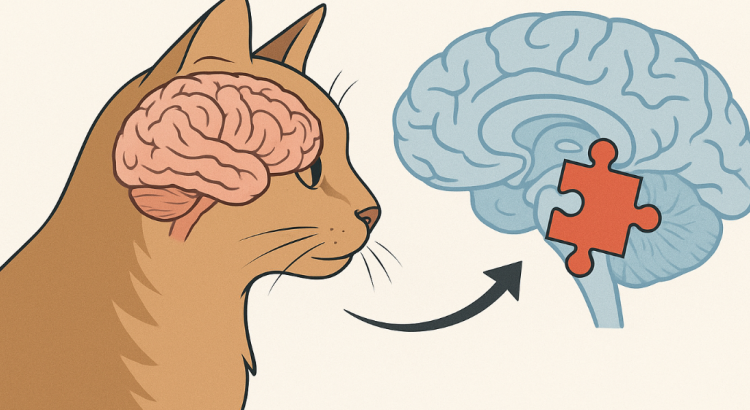
Researchers have uncovered striking parallels between dementia in cats and Alzheimer’s disease in humans, opening new avenues for medical research that could benefit both species. The findings, published by a collaborative team from the University of Edinburgh, the University of California, the UK Dementia Research Institute, and Scottish Brain Sciences, reveal that cats naturally develop brain changes akin to those seen in humans with Alzheimer’s, offering a promising new model for studying the disease.
The research focused on the brains of 25 deceased cats that had displayed dementia-like symptoms during their lives, such as disorientation, disrupted sleep patterns, and increased vocalization. Microscopic analysis revealed a buildup of amyloid-beta, a toxic protein long associated with Alzheimer’s, clogging the synapses—critical junctions where brain cells communicate. In humans, this synaptic damage is a hallmark of memory loss and cognitive decline. The discovery that cats exhibit similar pathology suggests they could serve as a more accurate model for Alzheimer’s than the genetically modified rodents traditionally used in labs, which do not naturally develop dementia.
Dr. Robert McGeachan, the study’s lead researcher at the University of Edinburgh’s Royal (Dick) School of Veterinary Studies, emphasized the potential impact. “Cats offer a unique window into Alzheimer’s because their brain changes occur naturally, unlike the artificial models we’ve relied on,” he said. “This could accelerate the development of treatments not only for humans but also for our aging feline companions.”
The implications are profound. Current Alzheimer’s research often depends on rodent models engineered to mimic the disease, but these models fall short of replicating the complex, natural progression seen in humans. Cats, by contrast, develop amyloid-beta plaques and cognitive decline spontaneously, mirroring the human condition more closely. This makes them a “perfect natural model,” as the researchers describe, for testing therapies aimed at halting or reversing synaptic damage.
The study also holds promise for veterinary medicine. Feline cognitive dysfunction, a condition affecting older cats, shares symptoms with human dementia, including confusion and behavioral changes. By better understanding the role of amyloid-beta in cats, scientists hope to develop treatments to improve the quality of life for aging pets, a growing concern as cats live longer due to advances in veterinary care.
Funded by Wellcome and the UK Dementia Research Institute, the research marks a shift in how scientists approach Alzheimer’s. Rather than relying solely on lab-engineered animals, researchers can now study a naturally occurring model that lives alongside humans—potentially speeding up the translation of findings from lab to clinic. The team plans to explore whether experimental Alzheimer’s drugs, such as those targeting amyloid-beta, could be tested in cats, offering dual benefits for human and animal health.
As the global population ages and Alzheimer’s cases rise, the need for effective treatments grows urgent. With cats now positioned as unexpected allies in this fight, the bond between humans and their pets may extend beyond companionship to a shared pursuit of answers in the battle against dementia.